Please note: some of the links below are affiliate links. If you buy through one of them, RigTested may earn a commission at no extra cost to you. We only link gear we've actually run, and this guide reflects what we'd actually buy for a working property in 2026.
A trail camera used to mean clipping a unit to a tree at the edge of a hunting lease, then driving out every second Sunday to flip a memory card. That workflow is dead. The right camera today either talks to your phone over LTE or runs itself on a panel so you never have to leave the driveway at all. For a property, that changes the whole job. You're not scouting for deer anymore, you're watching for the neighbor's dog, the coyote pack that hit the goat pen, or the guy in the lifted truck that parks in your cut every winter.
Here are four worth a look for a quarter-section. Below is what each does well, which we would buy, and the one real gotcha that costs people money. All prices are what they list for right now.
The cameras, at a glance
| Camera | Connectivity | Best for | Price |
|---|---|---|---|
| TACTACAM Reveal X 3.0 | Cellular LTE | Remote property, no data plan hassle | See price |
| Moultrie Edge 3 (2-pack) | Cellular LTE | Covering two fence lines for under $100 | See price |
| MAXDONE Solar (2-pack) | Wi-Fi / BT + solar | Sites you can't reach for battery swaps | See price |
| DEATTI 4K 48MP | Wi-Fi / BT | Budget, closer to the homestead | See price |
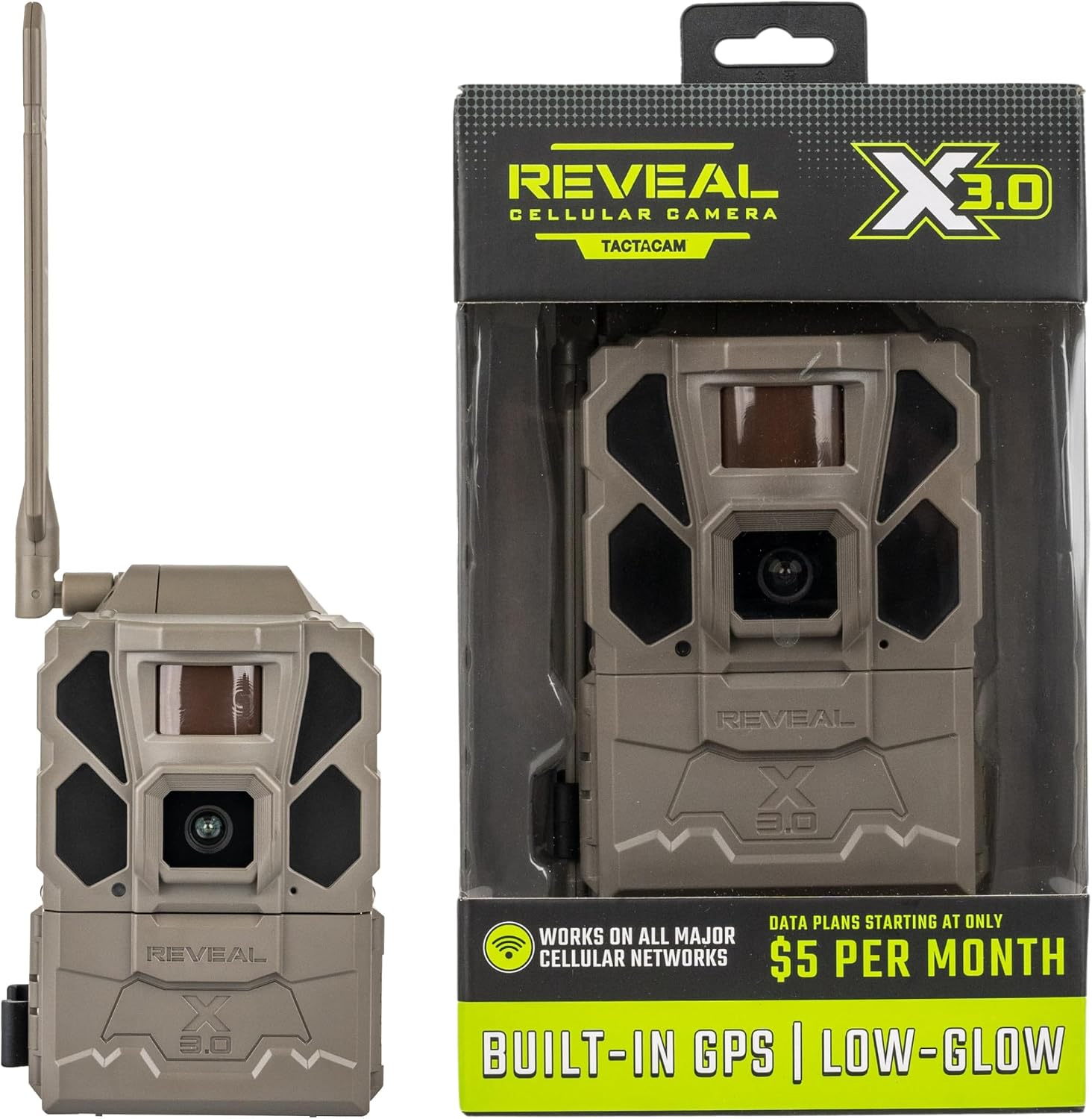
TACTACAM Reveal X 3.0, best cellular camera for a place

At $99.99, this is the one I'd start with if the property sits a mile and a half from the house and the nearest tree line is where trouble shows up. It shoots 4K stills and 1080p video and pushes them straight over LTE, so there's no SD card to flip. It auto-connects across carriers, which matters because dead zones that kill one network often let another through. Battery life is claimed at six months or more on a full set.
Real talk on running it: clip it to the fence post on the east boundary and set it to burst on motion. What actually sold me is the trigger lag. I was timing it against a dog crossing the gate in slow motion, and it caught the crossing before the tail was even off frame. The IP66 rating is not just a spec here. I had it sit through a week of sideways rain on a July storm and the lens came out clean after a rub with a rag.
The one honest caveat is the data plan. It needs a subscription to push anything at all, and you're paying for that separately. If you only need the cam during high-pressure seasons, you can drop the service and it becomes a card-based unit, but you lose the reason to buy a cellular camera in the first place. If you're also running a dash cam on the truck and want to cover the hours you're not driving, this is the other half of that security story. We walk through that setup in our guide to best dash cams for overlanding rigs.
Moultrie Edge 3 in a two-pack, best value for covering more ground

Two units, multi-carrier, 40MP stills, and a 0.5 second trigger, all for $99.00. That second unit is the whole deal. You can put one on the north gate and one at the water tank, and both talk to the same app. The low-glow flash is the quiet win here. It won't blind a deer at 2 a.m., so the shots you get back are of animals you'd actually want to see, not a wall of red light where a face should be. It also does GPS, which sounds trivial until the cam is pulled or shifted and you need to walk the line knowing exactly where the unit should be, not where you think you left it.
Mounting it is where the price shows. It has a standard strap mount, but I ended up adding a short steel cable through the strap loop for the gate unit because a single plastic tab on a fence line is one determined person's worth of trouble. For a property with more than one entry, this is the buy. It's the camera you point at the places you can't be and still get a clear picture of what crossed.
MAXDONE solar two-pack, best for sites you never want to think about again

$119.99 for two 4K units that run off their own panels. These are Wi-Fi or Bluetooth rather than cellular, so the panel is the whole point, not a bonus. You hang them high, where the sun hits the panel all day, and they keep themselves charged through the off-season. For the far corner of the section, or the back field where there's no grid and no road access for half a year, this is the setup that stops being a chore. You set it once and only drive out if the app stops getting a signal.
There's a real trade you have to plan for. Wi-Fi and Bluetooth both need you within range to pull the media, so these aren't "watch from the truck on the interstate" cameras the way the cellular units are. The 32GB card is included, which is a nice touch because you're not adding a card purchase on top. If your problem is battery and card swaps at a place you hate driving to, run the solar pack. If your problem is distance, go cellular. For keeping any off-grid gear alive this way, the panels do the same job at bigger scale in our look at best portable solar panels.
DEATTI 4K 48MP, best budget camera for the homestead

$59.99, a 0.1 second trigger, 48MP stills, eight batteries in the box, and a 32GB card. This is the camera for the part of the property you can actually reach on foot, the driveway, the workshop, the run where the hogs get out. The 0.1 second trigger is the reason it's here at this price. It's fast enough that a car on the gravel reads as a car with a driver, not a smear. Wi-Fi and Bluetooth again, so you pair your phone at the tree and pull the shots. The eight batteries matter more than they sound. On a budget camera, dying batteries are how the whole thing quietly stops, so having a full fresh set to start is what keeps it alive through January.
It won't run itself out in the field the way the solar and cellular packs will. You're swapping batteries on a schedule, and at this price I'd run it where swapping takes you five minutes, not forty. It's the workhorse when the job is close to the house and the budget is real.
Which one, in one line each
If you want push-to-phone from a far, hard-to-reach spot, the TACTACAM Reveal X 3.0 is the cleanest single buy. If you need two places covered without doubling the outlay, the Moultrie Edge 3 two-pack does it under a hundred. If your real problem is that you can't get to the cam to swap anything, the MAXDONE solar two-pack removes that job entirely. And if the spot you're watching is close enough to walk to and the budget is tight, the DEATTI earns its price on trigger speed alone.
Most people end up running a mix. A solar unit at the far corner that never needs attention, and a cellular unit at the main gate that you check from the couch. That pairing is the actual answer for a working property. You pay a little more up front and stop spending a weekend a month crawling the fence line to check a thing that should just work.
Whatever mix you run, check what's actually moving on price before you order. These rotate fast, and a cellular camera that's $99 this week is routinely a full fifty less a few days later if you catch the right listing. The RigTested deals page tracks the gear in this guide, so it's the faster way to find out if the camera you want is already at the price you were hunting.
Get the gear that holds up
New guides, hands-on reviews as they land, and real deals, about once a week. No spam, unsubscribe anytime.