Affiliate disclosure: as an affiliate partner, RigTested may earn from qualifying purchases through links on this page, at no extra cost to you.
Disclosure: Some links in this post are affiliate links, meaning we may earn a commission if you make a purchase at no additional cost to you.
The case for dedicated cooling
Off-grid travel presents unique thermal challenges that standard household appliances were never designed to handle. The heat load inside a vehicle parked in the sun can exceed 100°F, while the constant vibration of rough terrain stresses mechanical components. A standard soft cooler relies on ice or frozen blocks, which melt and dilute your food. A household mini-fridge is heavy, lacks robust mounting points, and often draws more power than a dedicated unit.
A dedicated overlanding fridge uses compressor technology to actively remove heat rather than relying on phase-change materials. On an overland rig, reliability matters more than raw capacity. If the unit fails due to poor battery management or vibration damage, you lose your food supply in remote areas where resupply is days away. The goal is consistent temperature maintenance with minimal power draw.
Critical specs for off-grid use
The primary metric for a 12V fridge is energy efficiency. Compressor fridges vary significantly in amp draw depending on whether they are cooling down or maintaining temperature. Look for units that specify their average wattage or amperage during the maintenance phase, not just peak startup current.
- Thermal Insulation: Thicker foam walls reduce the workload on the compressor. Better insulation means less runtime per day, preserving battery life.
- Vibration Resistance: Internal mounting systems and robust door latches prevent leaks and component failure when driving over washboard roads or rock piles.
- Battery Protection: Modern units include 3-level battery protection that cuts power before your vehicle's starter battery drops below a critical voltage threshold.
Top contenders: High-performance 12V fridge options
We compared several units on published specs, build, and price. Here are the top three choices for different needs.
EUHOMY 59QT 12 Volt Refrigerator
This is our pick for heavy-duty overlanding where space is not a primary constraint. The EUHOMY 59QT 12 Volt Refrigerator offers substantial capacity for multi-day trips with multiple occupants. It features ECO and MAX modes, allowing you to adjust cooling intensity based on ambient temperature. The 3-level battery protection is a critical safety feature when running off a deep-cycle bank. At $259.99, it provides a balance of size and feature set suitable for full-time living rigs.
BougeRV 12v refrigerator 23 Quart (Black)
For those who need freezer capability without the bulk of a large unit, the BougeRV 12v refrigerator 23 Quart is an excellent middle ground. It cools down to -8℉, making it a true freezer for meat and ice cream. BougeRV rates it to cool down to 32°F in about 15 minutes. At $156.99, it offers strong value for its temperature range and compact footprint.
BougeRV 12v refrigerator 23 Quart (Grey)
Identical in function to the black model but available at a slightly lower price point, the BougeRV 12v refrigerator 23 Quart is a solid choice if color preference allows. It shares the same -8℉ to 50℉ range and fast cooling claims. At $151.98, it represents one of the best price-to-performance ratios for a dedicated compressor unit in this size class.
Compact & lightweight portable car fridge picks
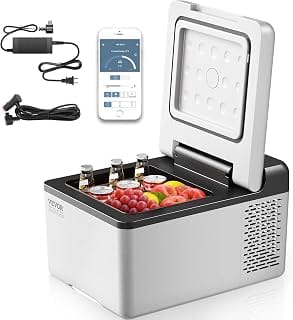
VEVOR 12V Car Refrigerator 10 QT, Portable Mini Free
$109.9
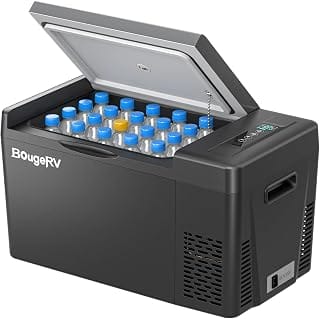
BougeRV 12v refrigerator 23 Quart, -8℉~50℉ Portable
$156.99
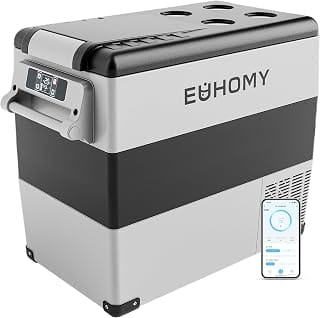
EUHOMY 59QT 12 Volt Refrigerator, -4℉~68℉ Portable F
$259.99
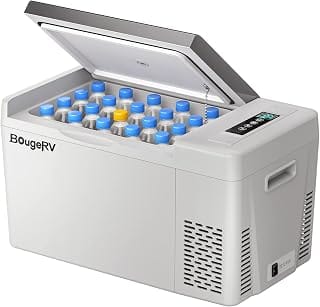
BougeRV 12v refrigerator 23 Quart, -8℉~50℉ Portable
$151.98
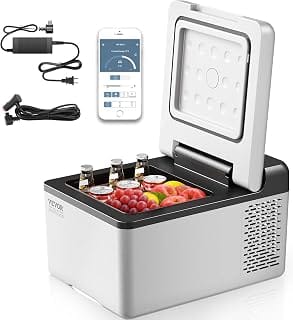
If cargo space is tight or you are traveling solo, smaller units offer significant weight savings. The VEVOR 12V Car Refrigerator 10 QT at $109.9 is ideal for short trips or as a secondary beverage cooler. Its APP control feature allows you to adjust settings remotely, which is convenient when the unit is stowed in a hard-to-reach location like under a seat or in a roof rack box.
The trade-off with smaller units is cooling speed. A 10-quart unit will reach target temperature faster than a 59-quart unit because there is less air volume to displace. However, in high ambient temperatures (above 90°F), even compact units may run their compressors more frequently to maintain internal temperature.
Powering your fridge: Battery & solar integration
Running a compressor fridge directly from your vehicle's starter battery is risky if the engine is off. We recommend using a dedicated deep-cycle AGM or Lithium battery bank for 12V fridges. A minimum of 100Ah capacity provides a buffer for several days of use, depending on ambient temperature and duty cycle.
Solar input helps offset consumption. While we do not specify exact wattage requirements as they vary by panel efficiency and sun exposure, check the manufacturer's rated consumption for your model and size your battery and panel to it. Proper fusing (typically 30A to 50A depending on gauge) and appropriate wire thickness are non-negotiable for safe operation.
If you would rather run the fridge from a portable battery, our power station guide covers that setup, and the solar panel guide covers recharging it.
How to choose: Decision framework
- Capacity vs. Trip Duration: For trips under 3 days, a 10-23 quart unit is sufficient. For week-long expeditions with fresh food needs, aim for 40+ quarts.
- Dual-Zone vs. Single-Zone: Dual-zone units allow you to keep one side as a fridge (32°F+) and the other as a freezer (-8℉). If you need to store frozen meats alongside fresh produce, dual-zone is essential.
- Noise & Interface: Check decibel ratings if you plan to sleep near the unit. Simple button interfaces are easier to use at night than complex app controls when power may be limited.
Common mistakes & maintenance tips
Avoid using standard cigarette lighter adapters for extended off-grid use. These often lack proper voltage regulation and can overheat under continuous load. Use a dedicated DC-DC converter or direct wiring to your battery bank with inline fusing. Every 12V load you add to that circuit — a fridge, a 12V truck fan, a dash cam — draws on the same battery, so tally them up before a long overnight stop.
- Cleaning: Wipe down the interior with mild soap and water after trips to prevent odor buildup in the sealed environment. Ensure the unit is dry before closing the door.
- Door Seals: Check gaskets for cracks or debris after long-term storage or exposure to extreme temperature swings. A compromised seal leads to ice buildup and higher power consumption.
FAQ: Overlanding fridge questions
Can I run a 12V fridge directly from my car’s battery while driving?
You can, but it is not recommended for extended periods with the engine off. When driving, the alternator charges the starter battery, providing ample power. However, if you park and turn off the engine, the fridge will drain your starter battery. Use a dual-battery setup or a dedicated deep-cycle bank for safety.
What is the difference between a 12V and 24V fridge?
The voltage input differs. Most consumer vehicles use 12V systems. Some heavy-duty trucks, boats, and RVs use 24V systems. Ensure your fridge supports the voltage of your vehicle's electrical system to avoid damage.
How long will a portable car fridge last on a single battery charge?
This depends on ambient temperature, set point, door opening frequency, and battery capacity. In moderate temperatures (70°F), a 100Ah deep-cycle battery might power a 23-quart fridge for several days. In extreme heat (100°F+), runtime may drop to 24-48 hours.
Final verdict & next steps
For heavy-duty overlanding with multiple occupants, the EUHOMY 59QT offers the best capacity and feature set. For solo travelers or those prioritizing value and freezer capability in a compact form factor, the BougeRV 23 Quart models are hard to beat.
Check current availability for these units before purchasing, as stock can fluctuate. Verify that your vehicle's electrical setup supports the required amperage draw. Share your own cooling setups in the comments below; we are always interested in hearing how other rigs handle heat management off-grid.
| Product | Capacity | Temp Range | Price | Key Feature |
|---|---|---|---|---|
| EUHOMY 59QT | 59 QT | -4℉ to 68℉ | $259.99 | Large capacity, ECO/MAX modes |
| BougeRV 23QT (Black) | 23 QT | -8℉ to 50℉ | $156.99 | Fast cooling, true freezer temp |
| BougeRV 23QT (Grey) | 23 QT | -8℉ to 50℉ | $151.98 | Value option, same specs as Black |
| VEVOR 10QT | 10 QT | -4℉ to 68℉ | $109.90 | APP control, compact size |
🔥 Live deals, updated daily
Prices on the gear we cover move constantly. We track current discounts on 12v portable fridges for overlanding and the rest of the gear we cover and refresh them every morning.
See today’s live deals →This guide was produced with AI assistance and reviewed by our team.
Related guides
- Overland power guide: the full cluster in one place
- 12V truck fans
- Power banks
- Overlanding must-haves
Get the gear that holds up
New guides, hands-on reviews as they land, and real deals, about once a week. No spam, unsubscribe anytime.